What Happened: Anthropic Ships Claude Opus 4.7
On 16 April, Anthropic officially released Claude Opus 4.7 — the company's most capable generally available model to date. According to Mashable, the new frontier AI model is available now, marking another significant step in Anthropic's ongoing effort to build powerful, safety-conscious AI systems. The release was covered widely across tech publications, with particular attention paid to the model's expanded feature set and what it means for developers, businesses, and anyone who relies on large language models in their daily work.
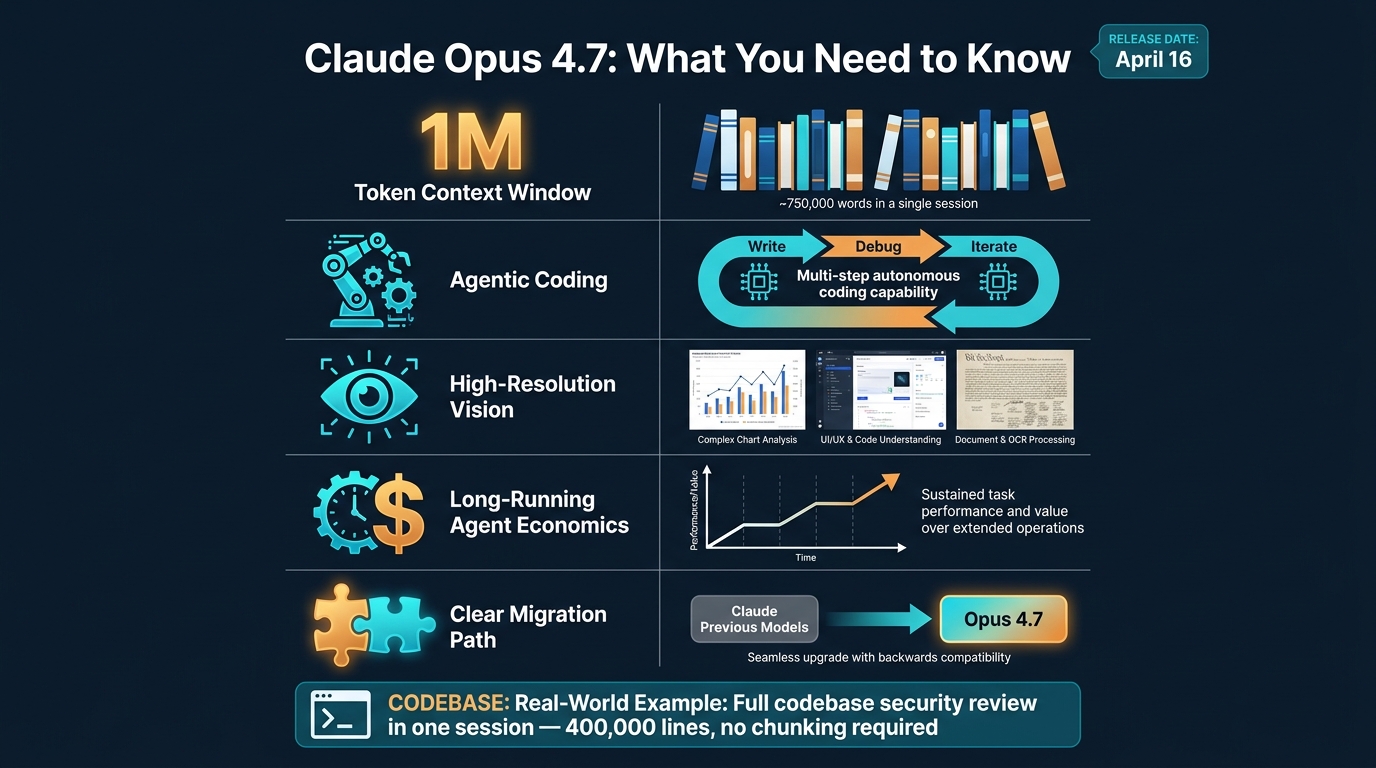
This is not just an incremental update. According to a detailed analysis by Caylent, Claude Opus 4.7 arrives with stronger agentic coding capabilities, high-resolution vision, a 1M token context window, and a migration story that — in Caylent's words — "matters almost as much as the benchmark scores." That last point deserves attention, because it signals that Anthropic is thinking not just about raw performance, but also about how organisations can practically adopt and transition to the new model.
The Most Interesting Features of Claude Opus 4.7
Let's walk through the standout capabilities that make this release worth paying attention to.
1. One Million Token Context Window
Perhaps the most eye-catching specification is the 1M (one million) token context window. To put that in perspective, one million tokens is roughly equivalent to 700,000–750,000 words — or about ten full-length novels. This means you can feed the model entire codebases, lengthy legal documents, full research papers, or months of conversation history without needing to chop content into smaller pieces. For businesses dealing with large datasets or complex documentation, this is a practical improvement that directly reduces the friction of working with AI.
2. Stronger Agentic Coding
According to Caylent, Claude Opus 4.7 brings notably improved agentic coding abilities. "Agentic" here means the model can take on multi-step tasks more independently — writing code, testing it, debugging issues, and iterating on solutions without constant human hand-holding. This is particularly relevant for software development teams who are experimenting with AI-assisted coding workflows. Rather than just generating a single code snippet, the model can reason through a problem across multiple steps and produce more complete, functional results.
3. High-Resolution Vision
The new model also includes high-resolution vision capabilities. This means Claude Opus 4.7 can process and reason about images at a higher fidelity than its predecessors. Whether you're analysing charts, interpreting screenshots, reviewing design mockups, or extracting information from scanned documents, the improved vision processing opens up practical use cases that go well beyond text-only interactions.
4. Long-Running Agent Economics
Caylent's analysis draws specific attention to what it calls "the new economics of long-running agents." As AI models become more capable of sustained, independent work — running tasks over extended periods rather than responding to single prompts — the cost structure and reliability of those operations become critical business considerations. Claude Opus 4.7 appears to be designed with these longer agent sessions in mind, which is relevant for any organisation looking to deploy AI agents for ongoing tasks like code review, data monitoring, or customer support triage.
5. A Migration Path That Matters
Anthropic hasn't just dropped a new model and walked away. According to Caylent, the migration story for moving from earlier Claude models to Opus 4.7 is a significant part of the release. For businesses already running applications on Claude's API, having a clear, well-documented upgrade path reduces the risk and effort involved in adopting the newer model. This is the kind of practical, operational detail that often gets overlooked in the excitement over benchmarks, but it matters enormously for real-world adoption.
A Practical Example: Using the 1M Context Window for Code Review
Imagine you're a development lead at a mid-sized software company. Your team has a monorepo containing around 400,000 lines of code across several microservices. Previously, asking an AI model to review or reason about the entire codebase required splitting it into chunks, losing context between sessions, and manually stitching insights together.
With Claude Opus 4.7's 1M token context window, you could, in theory, feed in a substantial portion of that codebase in a single session. You might prompt the model like this:
"Here is the full source code for our payment processing service and its associated test suite. Please review the code for security issues, identify any functions that lack adequate error handling, and suggest improvements to our retry logic in the API integration layer."
The model can then reason across the entire codebase in context, spotting patterns, inconsistencies, and risks that would be difficult to catch when working with fragmented chunks. Combined with the stronger agentic coding capabilities, it could even draft pull requests with suggested fixes — turning a multi-hour manual review into something far more manageable.
This is not a theoretical scenario. Development teams are already using large-context AI models for exactly this kind of work, and the jump to 1M tokens makes it feasible for significantly larger projects.
Why It Matters: The Bigger Picture
Claude Opus 4.7 arrives at a moment when the AI industry is moving beyond simple chatbot interactions toward more sustained, complex, and business-critical applications. The combination of a massive context window, improved coding agency, better vision, and thoughtful migration support suggests that Anthropic is building for the enterprise use case — not just the casual user asking a quick question.
For businesses, the practical implications are clear. Larger context windows mean fewer workarounds. Better agentic behaviour means less supervision overhead. High-resolution vision means more types of documents and media can be processed. And a clean migration path means lower switching costs.
The question for most organisations is no longer "should we use AI?" but rather "which model fits our specific needs, and how quickly can we adopt it?" With this release, Anthropic is making a strong case that Claude Opus 4.7 deserves serious consideration.
What Comes Next
As with any major model release, expect the AI community to spend the coming weeks stress-testing Claude Opus 4.7 across a wide range of tasks — from creative writing and research to complex engineering and data analysis. Benchmark comparisons with competing models from OpenAI and Google will inevitably follow, and real-world user feedback will ultimately determine whether the improvements live up to the promise.
For now, the model is available and ready to try. If you've been waiting for a reason to revisit your AI toolkit, this is a good moment to do so.
Need Help Making Sense of AI for Your Business?
Keeping up with new AI models, understanding which features matter for your use case, and actually putting them to work — that's where many businesses get stuck. Brain.mt can help you use AI effectively in your organisation. Whether you need guidance on selecting the right model, integrating AI into your workflows, or training your team to work confidently with these tools, get in touch for more information. Brain.mt also offers dedicated workshops and training sessions on this subject, designed to give you practical, hands-on skills rather than just theory. 🚀