
Anthropic has released Claude Opus 4.8, the newest version of its Claude AI model. While many AI updates focus on speed or expanded context windows, this release takes a different angle: honesty. According to Mashable, Claude Opus 4.8 has been described as the 'honest' Anthropic AI, placing truthful and direct responses at the centre of its design philosophy. For anyone using AI in professional settings — writing, coding, research, strategy — this shift matters more than you might think. Let's break down what's new, what's changed in behaviour, and how you can actually start using it today.
What's New in Claude Opus 4.8?
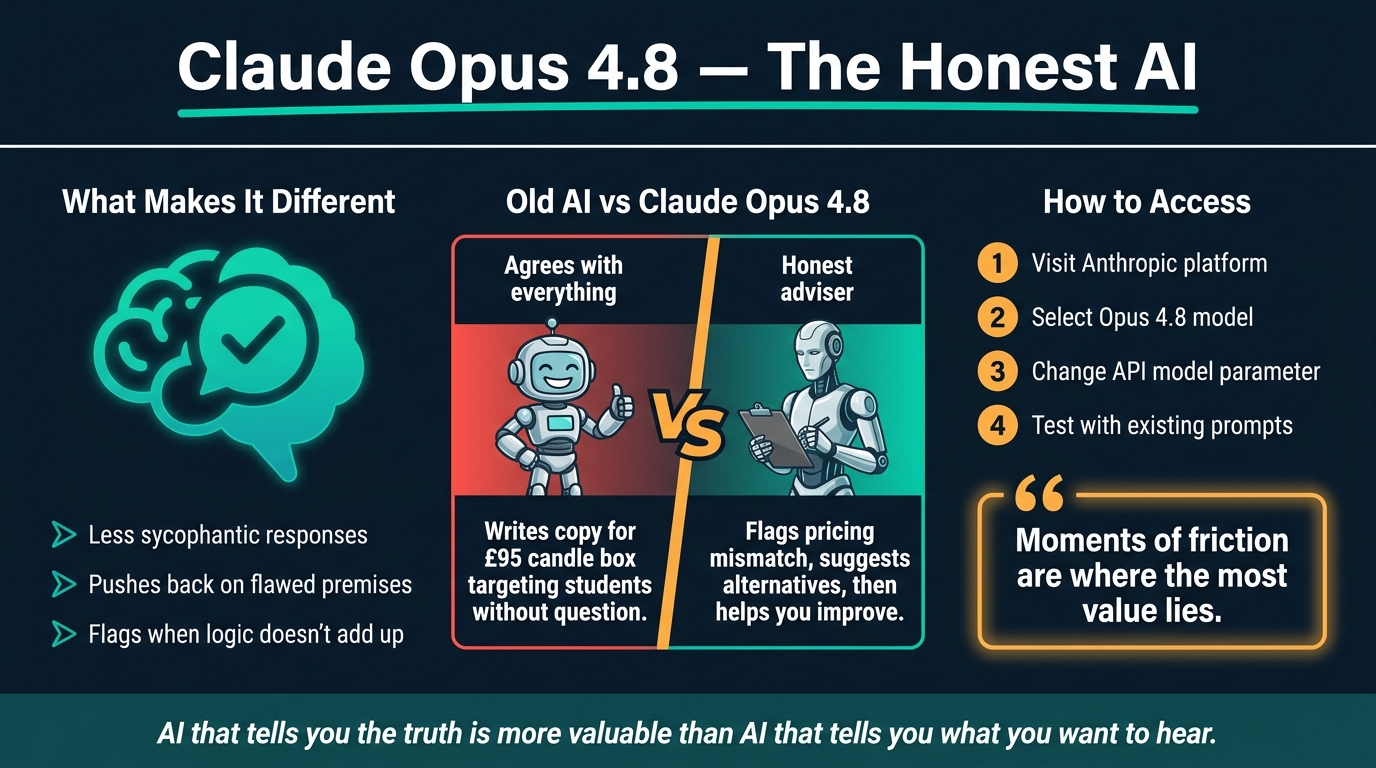
According to Anthropic's own API documentation, Claude Opus 4.8 introduces a range of new features and behaviour changes compared to earlier versions. The model has been tuned to provide more candid, less sycophantic responses. In plain terms, this means Claude is less likely to simply agree with you or tell you what you want to hear. Instead, it aims to give you accurate, well-reasoned answers — even when that means pushing back on a flawed premise in your prompt.
This is a meaningful change. One of the most common criticisms of large language models is their tendency toward agreeability. If you ask a poorly framed question, many AI models will still produce a confident-sounding answer that validates your assumption. Claude Opus 4.8 is designed to resist that pattern. It will flag when something doesn't add up and offer a more grounded perspective. For professionals relying on AI for decision support, content creation, or data analysis, this kind of honest feedback can prevent costly mistakes.
How to Try Claude Opus 4.8
As reported by Mashable, Claude Opus 4.8 is now available for users to try. You can access the model through Anthropic's platform and API. If you already have an Anthropic account or use the Claude interface, you should be able to select the Opus 4.8 model for your queries. Developers integrating Claude via the API can refer to Anthropic's official documentation for details on how to specify the model version in their requests.
For businesses already using Claude in their workflows, upgrading to Opus 4.8 could be as simple as changing the model parameter in your API calls. For newcomers, it's worth signing up and experimenting with the model directly through the Claude chat interface to see how its responses differ from what you may be used to with other AI tools.
A Practical Example: Getting Honest Feedback on a Business Idea
Here's a concrete scenario that shows why this honesty-first approach matters. Imagine you're a startup founder and you prompt an AI model with:
"I'm planning to launch a subscription box service for artisanal candles priced at £95 per month. The target audience is university students. Can you help me write marketing copy for this?"
A typical AI model might cheerfully produce the requested marketing copy without questioning the obvious mismatch between a premium price point and a student audience with limited disposable income. Claude Opus 4.8, with its emphasis on honest responses, is more likely to first point out the tension in your plan — noting that the pricing may not suit the target demographic — before helping you refine the idea or adjust your approach. It might suggest a lower price tier, a different audience segment, or a gifting angle.
This kind of response is far more useful than blind compliance. You still get the help you asked for, but you also get a reality check that could save you time and money. It's the difference between an AI that acts like a yes-person and one that acts like a thoughtful adviser.
Why Honesty in AI Matters for Your Work
The move towards more honest AI isn't just a technical curiosity — it has real implications for how businesses and professionals use these tools. If you're using AI to draft proposals, review strategies, write code, or analyse market data, you need responses you can trust. An AI that defaults to flattery or avoids contradicting you is, frankly, less useful than one that tells you the truth. Claude Opus 4.8 represents a step in the right direction for making AI a more reliable working partner rather than just a text generator that agrees with everything you say.
For teams that rely on AI-assisted workflows, this update is worth testing. Try it with your existing prompts and pay attention to where Opus 4.8 pushes back or offers a different perspective. Those moments of friction are often where the most value lies.
Get Started with AI the Right Way
Whether you're exploring Claude Opus 4.8 or any other AI tool, knowing how to write good prompts and integrate AI into your business processes makes all the difference. Brain.mt can help you use AI effectively in your business — from selecting the right models to building practical workflows. Contact me for more information. I also offer dedicated workshops and training on this subject, designed to give your team the skills to work with AI confidently and get real results.